

Firstly, irrigation is a system where performance and efficiency rely on how all the tech parts work together to uniformly apply water. It functions in context of how it’s been hydraulically designed, how it’s installed and then also maintained. And it services the landscape by applying supplemental water to keep the plants healthy and alive. But, is it providing the plants with the right amount of water at the right time? Where is that water coming from? And how much is the irrigation system costing you?
1. Use Alternative Water
According to the Environmental Protection Agency (EPA), “if the average sized lawn in the United States is watered for 20 minutes every day for 7 days, it’s like running the shower constantly for 4 days or taking more than 800 showers. That’s equivalent to the amount of water needed for the average family to take 1 years’ worth of showers.”
This kind of water use isn’t possible in some countries (including South Africa) due to regulations, water availability, competition, vulnerable service delivery issues and the living through the reality of drought.
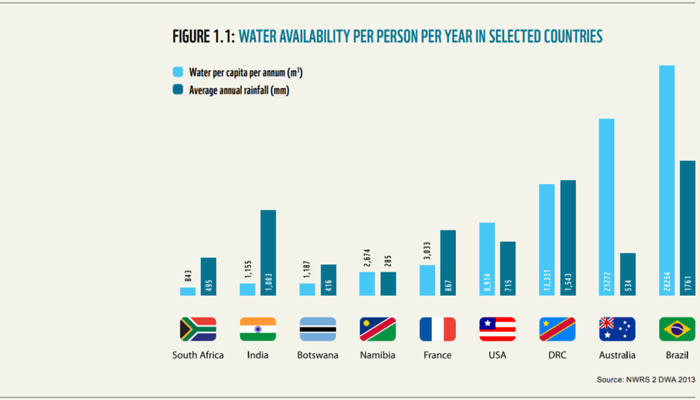
WWF-SA 2016, Water: Facts & Futures
So, on the demand side of the equation- you should investigate the cost-benefit ratios for replacing your potable water with water from an alternative source. It’s also a shrewd way to secure water for your project and manage the irrigation system costs.
And it feeds in to the obligation to protect water quality, aquatic environments and the weight of equitable water access. It’s important to not only look to water supply and demand, but also to maintain water quality.
The kind and quality of water source needs evaluation as it will affect your water availability, as well as the plant growth and development. Comply with all regulations, use the lowest acceptable quality of water and supplement with higher quality of water when you find it to be necessary.
Assess all sources of available on-site water:
- rainwater harvesting
- storm water capture
- graywater
- air conditioning condensate
- groundwater (boreholes)
When it comes to groundwater extraction you mustn’t exceed replacement rates so that your investment is maintained in the long term. The over commitment of a borehole leads to increased pumping costs , drying out of the borehole, and the loss of your landscape. Finding a sustainable level of extraction requires significant investment. and this is best done early in the process since recovering from over extraction is challenging.
Also add fit for purpose design and strategies like infiltration, storing and recycling of water, bioswales bioretention ponds, rainwater gardens and local water recycling and reuse.
2. Use a checklist during planning & design
On the water demand side, there are however factors that are easier to access and explore. Paying heed and using them during the planning and design phases helps to reduce any projected gaps between site water supply and then the landscape demand. This process also helps to keep the irrigation system costs under control.
In order to estimate and establish the amount of water required, when and where to irrigate and then how to better decrease landscape water use, different factors need to be brought together.
Site specific factors follow below:
- landscape size and shape of area to irrigate
- appropriate plant species selection
- knowledge of plant water requirements
- creating separate hydro zones
- appropriate soil and substrate conditions and type
- local / real time weather status and climate
(including effective rainfall and evapotranspiration) - irrigation system efficiency
(including sound hydraulic design, smart control technology and sensors, correct installation, and maintenance) - human intervention and behaviours
(such as water saving habits, suitable irrigation scheduling, targeted watering, correct system operation and monitoring)
It’s key that we all actively seek ways to decrease consumption of this resource. Paying heed to these factors during design and planning stages of your landscape project impacts water use and ensures that landscapes can be healthy with less water. And save you costs in the long term.
3. Install a dedicated irrigation water meter
It makes financial sense to accurately measure the amount of water used, in order to reduce your utility costs. What you measure, you can potentially manage and control. Without a meter, you don’t know how much water you’re actually using and whether your effort to use less is working. So does your urban green landscape have a dedicated irrigation water meter?
A pulse output water meter, installed and monitored, is an effective way of determining the amount of water used. You can take manual readings or simplify the task with loggers, and other technology that provide automated information. For more detailed irrigation data of the flow at each zone, use irrigation water meter modules or flow sensors which connect to a compatible controller.
You can estimate irrigation water use, however these calculations can vary from the actual amount of water your landscape uses. This estimate is based on the number and type of emitter as well as the irrigation schedule (and these values are usually set out in a newly built system in the form of a water budget or later during an irrigation audit.) You need to measure and record the data in order to extract the full value. Meters not only highlight water waste – undetected leaks also come to light.
4. Find and fix leaks
When should you invest in leak controls? Well, consider the impact of burst pipes, damages and the cost of repairs when making this decision. Also, keep in mind that most irrigation systems run late at night or early in the morning, making them invisible and unnoticed.
Small leaks add up to a significant loss of money over time. It follows that, if leaks are detected earlier, then the time to repair is quicker. This helps mitigate water loss, or damage to landscape and property. Determine which measures will benefit you most financially.
Specific leak reduction activities you can undertake
- Active leak controls:
*Invest in an automatic leak detection system which monitors and measures flow. These systems differentiate between normal flow and leaks, then sends an alarm about any excessive loss. They also have automatic shut off valves and can be used across all water systems. This means fast leak detection and faster time to repair.
*Irrigation flow sensors provide monitoring at zone level, detecting low or high flow. It sends an alarm notification and there’s options to have the zone switched off- which can help a great deal and save a huge amount of water. - Regular checks or audits:
Inspect the irrigation system during routine maintenance, work zone to zone, and read your water meter to identify leaks. - Passive:
This is when you simply react to visible leaks due to burst pipes or sprinkler heads.
5. Maintain your irrigation system
Don’t wait until something breaks- with a sound preventative maintenance programme, you’ll be able to identify issues early before they become a major problem. The most efficient system is maintained according to the equipment manufacturers’ and/or your irrigation designer’s specifications.
Regular and routine maintenance also extends the useful life of the system, ensures optimal operation and minimizes water waste. It helps to identify lack of uniformity and application efficiency. These are measures of how well an irrigation system delivers water to the plant root zones. Irrigation operators sometimes apply larger amounts of water, trying to solve this lack of uniformity. The primary source of low uniformity is faulty sprinkler nozzles as well as pressure differences along the system.
Common signs of a faulty automatic sprinkler system include:
- High water and energy bills
- Stressed landscapes
- Dry patches or areas with pooling water
- Sprinkler heads not working (Clogged, broken or stuck)
- Excess runoff or soil erosion
- Mixed sprinkler/nozzles with unmatched precipitation rates
- Low pressure at sprinkler heads
- High pressure with sprinkler heads misting
- Valves that don’t open or close, with zones that don’t turn on
- Leaking valves
Changes and modifications to the irrigation system will be necessary as the landscape matures.
It can’t be business as usual
What is clear is that we need to rethink the place of water in landscape. And also limit irrigation system costs. We need to understand where the water comes from, how we manage the landscape water demand and then how it’s actually delivered to the plants.
“While properly run water systems go largely unnoticed by the public, a water crisis- such as a (drought,) shutdown of facilities or rocketing prices generates immediate headlines and causes uproar. Unsustainable management and inequitable access to water resources cannot continue. We might not have all the information we would like to have before acting, but we do know enough now to begin taking significant steps”
– Water in a Changing World- UN World Water Development Report 3